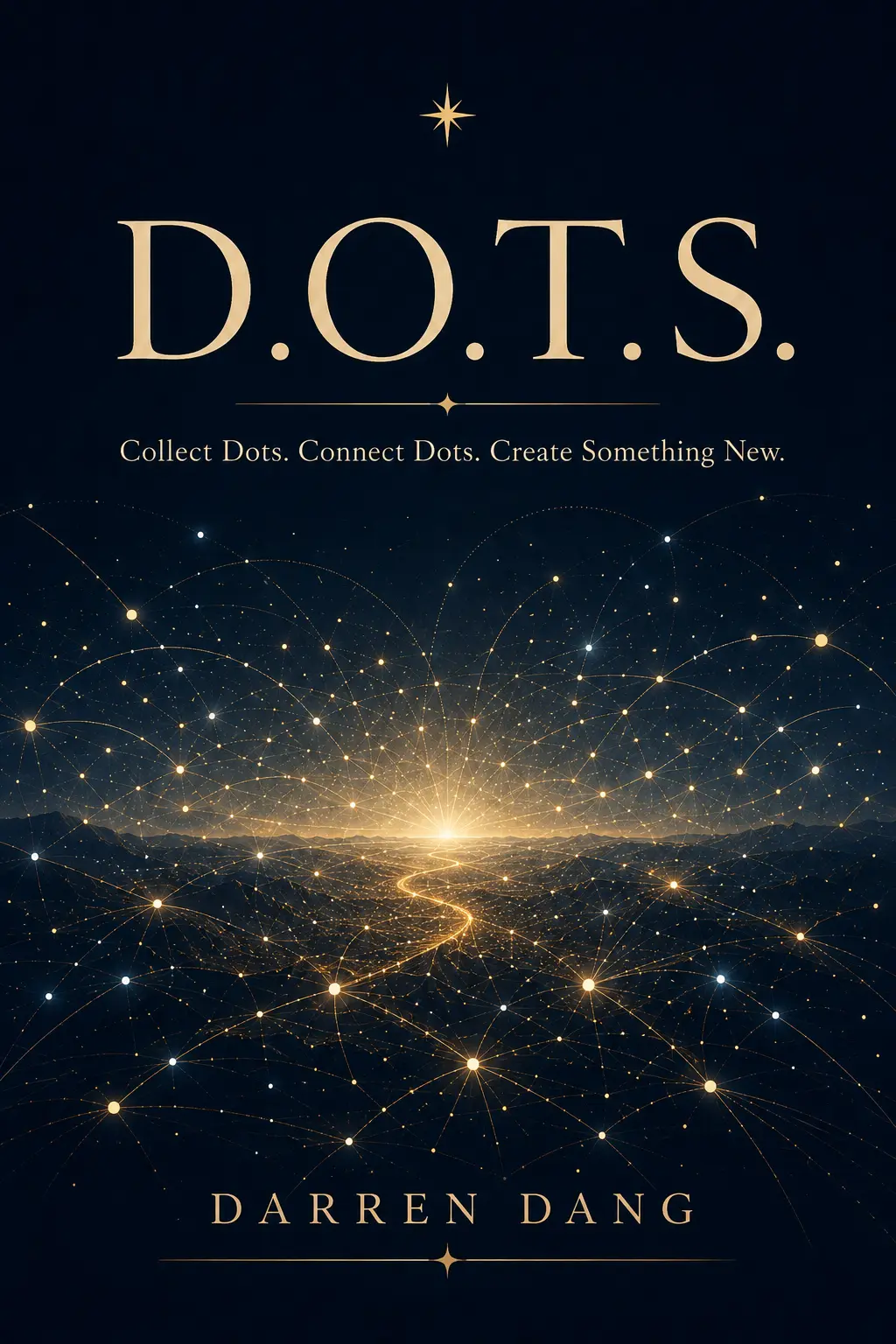
The Shape Beneath
The song follows the movement from collected fragments to structure, transfer, synthesis, experimentation, and the next dot. It is an artistic interpretation; the adjacent Book 3 text remains the authority for the D.O.T.S. and CREATE methods.
Read lyrics
Intro

The world gives us pieces before it gives us a plan.
The pattern came first. The language came late.

Verse 1

I kept the little fragments life was leaving in my hands,
A lesson from a failure, a question from another land.
A bottle turned to pocket change, a classroom changed the view,
And every field became a window when the old answer would not do.

I used to trust the labels like the labels knew the whole,
Till a tool from somewhere distant showed the structure down below.
The nouns were never equal, and the contexts never matched,
But underneath the surface, there was something we could catch.

Pre-Chorus

Strip away the name.
Look beyond the room.
Carry what is true, but leave the costume.

Chorus

Different surface, same shape,
Different road, same gate.
Take the principle, test the limit,
Let the evidence change it.
Collect the dots, connect them true,
Build something the world can answer to.
When the map runs out, let a new way through.
Collect dots. Connect dots. Create something new.

Verse 2

A map can hold experience, but a map is not a script.
Every borrowed answer has a border and a risk.
If I cannot name the breakpoint, then the transfer is not ready;
If the first idea feels perfect, find the voice that makes it heavy.

Two dots make a doorway; a third can change the aim,
Bring the law, the cost, the people who will carry what we make.
No single model holds the whole, no clever link is proof,
A candidate stays humble till reality speaks truth.

Pre-Chorus

Give the thought a form.
Make the wager small.
Learn before commitment.
Let the real world call.

Chorus

Different surface, same shape,
Different road, same gate.
Take the principle, test the limit,
Let the evidence change it.
Collect the dots, connect them true,
Build something the world can answer to.
When the map runs out, let a new way through.
Collect dots. Connect dots. Create something new.

Bridge

D — Deconstruct: take the label from the table.
O — Observe: find the field that had to learn.
T — Transfer: move the principle, not the costume.
S — Synthesize: let the different pieces turn.

C — Construct: give the possibility a body.
R — Reality-test: let the smallest honest trial begin.
E — Evaluate. A — Adapt. T — Translate. E — Extend.
Then return the lesson to the dots again.

Breakdown

Continue. Change. Pause. Stop. Extend.
The purpose can survive when the first design must end.
We are not chasing clever; we are building something true.
Reality is not the interruption. Reality creates with you.

Final Chorus

Different surface, same shape,
Different road, same gate.
Take the principle, test the limit,
Let the evidence change it.
Collect the dots, connect them true,
Build something the world can answer to.
When the map runs out, let a new way through.
Collect dots. Connect dots. Create something new.

Final Chorus

Collect the dots, but hold them lightly.
Connect the dots, but test them wisely.
Create the thing that no one handed you.
Leave the next dot where another life can find it too.

Outro

The world organizes knowledge into disciplines.
Problems do not.

Collect dots. Connect dots. Create something new.